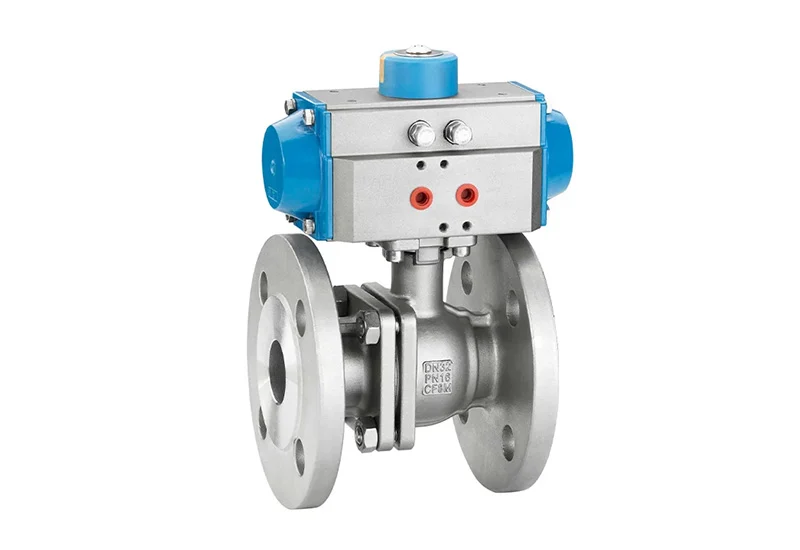
Automated ball valves serve as core components for achieving automatic control within piping systems. Utilizing electric or pneumatic actuators, they rotate the internal ball 90 degrees around the valve stem axis, enabling rapid shut-off, diversion, or redirection of the flow of media.
In modern fluid control systems, automation plays a vital role in enhancing efficiency, precision, and safety. This article explores the differences between automated ball valves and standard (manually operated) ball valves, examines the advantages of automated versions, and discusses their various applications to help you gain a better understanding of this technology.
Automated Ball Valves vs. Standard Ball Valves
The fundamental difference between an automated ball valve and a standard ball valve lies in the inclusion of an electric or pneumatic actuator, which allows for remote, automated control; in contrast, a standard ball valve relies exclusively on manual operation. Please refer to the table below for a detailed breakdown of the differences:
| Differences | Standard Ball Valves | Automated Ball Valves |
| Structural Composition | Consists solely of basic components such as the valve body, ball, stem, and handle; features a highly minimalist design with no additional power sources or electronic control modules. | Built upon the structure of a standard ball valve but equipped with an electric or pneumatic actuator, which incorporates components such as a motor, gearbox, position sensor, and overload protection. |
| Operation and Control | Rely entirely on manual operation via an on-site handle; they cannot be controlled remotely, and the precision of opening/closing is significantly influenced by the human operator. | Can be integrated into PLC/DCS systems and operated remotely via electrical or pneumatic signals. Advanced models are capable of high-precision, closed-loop flow regulation with an accuracy of ±0.5%. |
| Cost and Maintenance | Low-cost; maintenance requires only periodic inspection of the sealing surfaces, with no specialized expertise needed. | Priced at 3–5 times that of standard ball valves of the same specification; require professional personnel to inspect and service the electrical control and transmission components every 6–12 months. |
Advantages of Automated Ball Valves
Remote Automation and Centralized Control
Automated ball valves can be directly integrated into PLC/DCS systems, allowing for remote operation via standard signals (such as 4–20 mA) without the need for on-site personnel. They support industrial protocols like MODBUS, enabling inclusion in plant-wide centralized monitoring systems and facilitating unified scheduling across distributed piping networks.
Rapid Response and Control Precision
Small-scale valves can complete a full 90° opening or closing cycle in 1–5 seconds—significantly faster than manual operation. High-end regulating models offer control precision of up to ±0.5% and a repeatability error of ≤±0.1°, enabling accurate closed-loop flow regulation.
Safety and Operational Stability
Automated ball valves are designed for hazardous environments, including high-temperature, high-pressure, or toxic/harmful conditions, eliminating the safety risks associated with manual on-site operation. Actuators are equipped with overload protection and position feedback; in the event of a jam, the power is automatically cut off to prevent accidental equipment damage.
Low Maintenance Costs
Precise flow control prevents the waste of media and reduces overall system energy consumption, with long-term operational savings offsetting the initial procurement cost. Moving parts experience uniform wear, resulting in lower failure rates; consequently, the total lifecycle cost—including labor for operation and maintenance—is significantly lower than that of standard manual ball valves.
Applications of Automated Ball Valves
Petrochemical Industry: Suitable for handling oils, acids, alkalis, and other corrosive media. These valves provide remote, explosion-proof shut-off capabilities in flammable or explosive environments, making them standard components in refining facilities and oil and gas transmission pipelines.
Power and Metallurgy: Used in high-pressure auxiliary piping for power plants and fluid transport systems in steel and metallurgical production. They are capable of withstanding high pressure differentials and frequent cycling, ensuring stable operational conditions.
Pharmaceuticals and Food Processing: Sanitary-grade automated ball valves meet stringent clean-production requirements. They enable precise flow diversion and shut-off in pharmaceutical and food processing pipelines, eliminating the risk of contamination from manual handling.
Agriculture: These valves can be integrated into fertigation (water-fertilizer integration) systems to precisely control the mixing ratio and delivery of liquid fertilizers, serving as a key execution component in modern agricultural automation.
Municipal Water Supply: In municipal water supply and sewage treatment networks, these valves enable remote flow control, allowing for the rapid isolation of leak points and reducing the labor costs associated with network operation and maintenance.
Conclusion
Whether in high-pressure systems, applications involving corrosive fluids, or critical shut-off scenarios, these valves deliver rapid response times and reliable sealing performance—thereby minimizing the risk of leaks and the potential for costly downtime or production stoppages. Furthermore, they integrate seamlessly into automated control systems, supporting remote operation and predictive maintenance while optimizing process efficiency.
For enterprises looking to enhance safety and reliability while achieving long-term cost savings, automated ball valves represent a prudent investment—ensuring superior operational performance and providing users with greater peace of mind. Please feel free to contact us if you require further information.