In industrial piping systems, ball valves play a critical role in isolating or shutting off the flow of media. Structurally, ball valves can be designed as one-piece, two-piece, or three-piece units. While they share the same fundamental operating principle, they differ in how their internal components are assembled, the ease with which they can be maintained, and their specific application scenarios.
A key feature of the three-piece ball valve is its split-body design, which facilitates the inspection, repair, and replacement of internal components. This article explores three-piece ball valves in detail—covering their composition, advantages, and applications—to provide a comprehensive understanding of what they are.
Composition of a Three-Piece Ball Valve
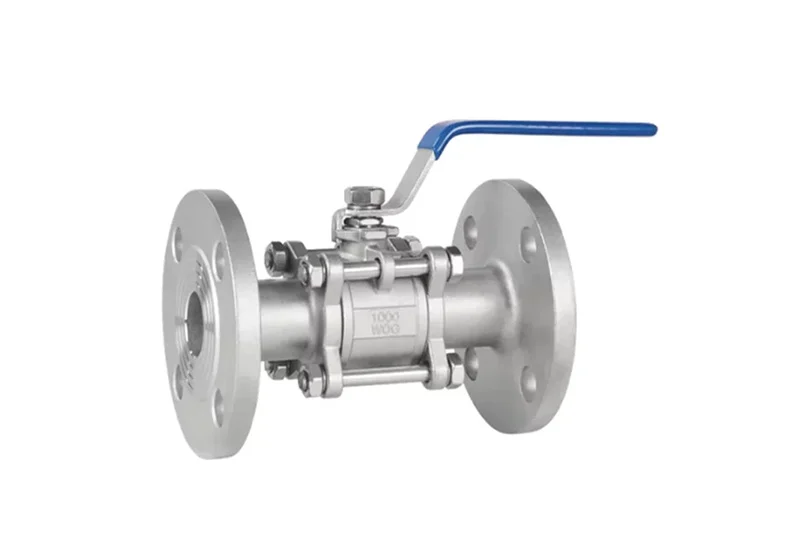
A three-piece ball valve is a device commonly used to control the flow of fluids within a pipeline. Unlike other types of ball valves, it consists of three distinct parts: two end connectors and a central section that houses the spherical valve core (the ball).
- Main Body: Houses internal components such as the ball and valve seats.
- Left End Cap: Connects to the pipeline and joins with the main body to create a pressure-containing chamber.
- Right End Cap: Connects to the other side of the pipeline, completing the overall valve structure.
The primary advantage of this design is that it simplifies maintenance, as individual components can be easily removed. Furthermore, because each part can be replaced separately, there is no need to remove the entire valve from the pipeline.
These valves are typically manufactured from stainless steel, carbon steel, or various other alloys to ensure durability and excellent corrosion resistance. Additionally, the use of high-quality sealing materials and packing is crucial for enhancing valve performance and extending its service life.
Advantages of Three-Piece Ball Valves
The core benefit of the three-piece design is that the valve can be disassembled without disturbing the pipeline or disconnecting the piping system. This offers the following advantages:
Ease of Maintenance: This is its most significant advantage. The central section of the valve body can be easily removed from the pipeline without affecting the pipe connections. In-line Maintenance: Seals, valve seats, and even the ball itself can be inspected, cleaned, repaired, or replaced without the need to cut into the pipeline.
Rapid Component Replacement: Should a part fail, it can be replaced quickly, allowing the system to return to operation in less time.
Ease of Cleaning: The valve body can be removed for thorough cleaning—a critical feature for applications involving viscous fluids or substances prone to leaving residue.
Reduced Downtime: Simplified maintenance procedures lead to significantly shorter periods of operational downtime for repairs.
Long-term Cost-Effectiveness: When viewed over the entire product lifecycle, the total cost of ownership is often lower. Savings on labor costs and reduced production losses typically more than offset any difference in the initial purchase price.
Lower Leakage Risk: Because the pipe connections remain undisturbed during maintenance, there is a lower risk of developing new leaks at the connection points compared to two-piece valves that require the pipeline to be disconnected.
Practical Applications of Three-Piece Ball Valves
With features such as a full-bore design (offering low flow resistance), rapid 90° opening and closing, and ease of disassembly for maintenance, three-piece ball valves are well-suited for a wide range of industrial applications. In the petrochemical sector and long-distance natural gas pipelines, they provide reliable shut-off and flow diversion for crude oil and volatile or explosive media. In steam pressure-reduction stations and municipal heating networks, they are ideal for high-temperature, high-pressure steam lines, enabling quick shut-off and in-line maintenance without the need for removal. Furthermore, in water treatment reverse-osmosis systems and sterile piping for the pharmaceutical and food industries, these valves utilize sanitary-grade materials to meet stringent cleanliness requirements. They can also be equipped with pneumatic or electric actuators, allowing for integration into industrial automation systems for remote, interlocked control.
Conclusion
A thorough understanding of valve specifications will help you make a better selection. If you are unsure about which three-piece ball valve to choose, please feel free to contact us. We are dedicated to providing the support you need to make the optimal choice.