As technology advances, the functionality of ball valves—a core component in industrial piping—continues to evolve. The advent of automatic ball valves has simplified operational workflows and significantly reduced the need for manual labor and the risks associated with operation and maintenance in industrial settings. Let’s examine the specific aspects of this “automation.”
- Automatic Opening and Closing
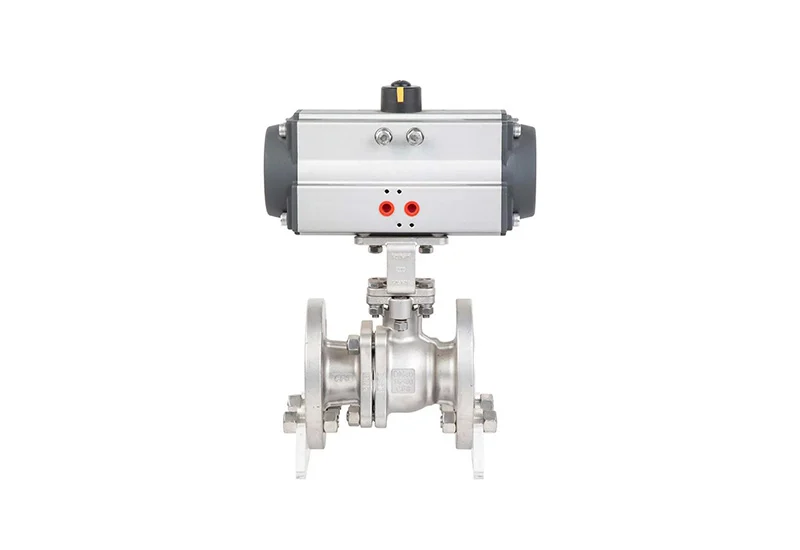
Traditional ball valves require manual actuation, meaning operators must physically interact with the valve to open or close it. In complex operating environments, prolonged manual operation can be hazardous. Automatic ball valves are equipped with electric or pneumatic drive modules that receive remote signals from a central control system to execute a 90-degree rotation, allowing commands to be carried out without direct physical contact with the valve.
- Automatic Flow Regulation
Powered by intelligent servo systems, automatic ball valves can automatically adjust the valve core’s opening angle based on real-time data—such as flow rate, pressure, and temperature—transmitted by upstream sensors. This effectively eliminates human error. Furthermore, the valve’s memory module stores multiple sets of regulation parameters; when switching production batches, operators can simply recall these settings with a single click to automatically adapt the valve, eliminating the need for recalibration.
- Automatic Data Logging
It is impossible to manually monitor and record a ball valve’s operating status at every moment. Consequently, malfunctions might go unnoticed, leading to delayed responses and potential long-term issues. Automatic ball valves feature built-in opening sensors and torque monitoring capabilities that automatically log operational data and track the valve’s condition. If anomalies such as valve core jamming or seal leakage occur, the device automatically triggers a warning signal and instantly identifies the fault location, thereby reducing troubleshooting time.
- Automatic Anomaly Handling
When pipeline pressure surges beyond a set threshold, the automatic ball valve automatically shuts off the flow to prevent high-pressure surges from damaging downstream equipment. If an abnormal rise in driving torque is detected, the valve automatically halts operation and reverses its position slightly to prevent damage to the valve core seal caused by forced actuation. Additionally, soft-seated models can automatically adjust seal compression based on the medium’s temperature; this prevents excessive seal wear in high-temperature environments and ensures zero-leakage sealing in low-temperature conditions, eliminating the need for manual adjustments to maintenance strategies in response to environmental changes.
Covtvalve’s automatic flanged ball valves feature electric or pneumatic actuators and achieve flow regulation precision of ±1%. They support 4–20mA and Modbus signals, enabling real-time monitoring of valve position and temperature. Capable of emergency shut-off within 0.5 seconds (SIL3 certified), these valves offer a 30% improvement in energy efficiency and a 50% reduction in maintenance costs compared to traditional valves.