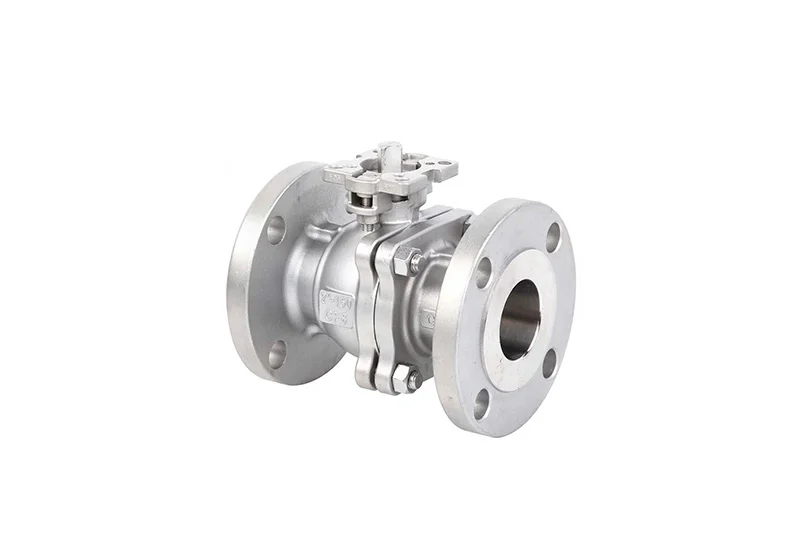
Flanged ball valves serve as core control components in industrial piping systems. Their most distinctive feature is the presence of flanges at both ends of the valve body, which connect directly to pipeline flanges via bolts. This design facilitates easy installation and removal while ensuring high connection strength, making them critical components in oil refining, long-distance natural gas pipelines, large-scale power plant water supply systems, and automated pharmaceutical piping.
Key Performance Characteristics
Extremely Low Flow Resistance: Flanged ball valves typically feature a full-bore design. When fully open, the internal flow path resembles a straight pipe, resulting in minimal flow resistance and maximizing the reduction of pressure loss during long-distance transport.
Bi-directional Sealing: Tight shut-off sealing is achieved regardless of the direction of medium flow.
Automatic Compensation Function: Soft-seated valves (e.g., PTFE) utilize the material’s elasticity to automatically adjust the sealing interface in response to pressure fluctuations; hard-seated valves achieve wear-resistant, metal-to-metal sealing through high-precision lapping.
Efficient Operation: A 90-degree rotation transitions the valve from fully open to fully closed. When paired with pneumatic or electric actuators, switching speeds can be as fast as 0.05 seconds.
Broad Operational Adaptability: Pressure ratings range from PN1.0 to PN42.0 MPa, and operating temperatures span from -196°C (cryogenic) to 550°C (high temperature), accommodating media ranging from clear liquids to high-viscosity slurries.
Blowout-proof and Anti-static Design: The valve stem features a bottom-entry design to prevent ejection caused by excessive internal pressure (blowout-proof); additionally, a built-in anti-static device dissipates static electricity generated by friction between the ball and the valve body, thereby mitigating fire or explosion risks.
Structural Features of Flanged Ball Valves
Opening/Closing Mechanism and Flow Path Design
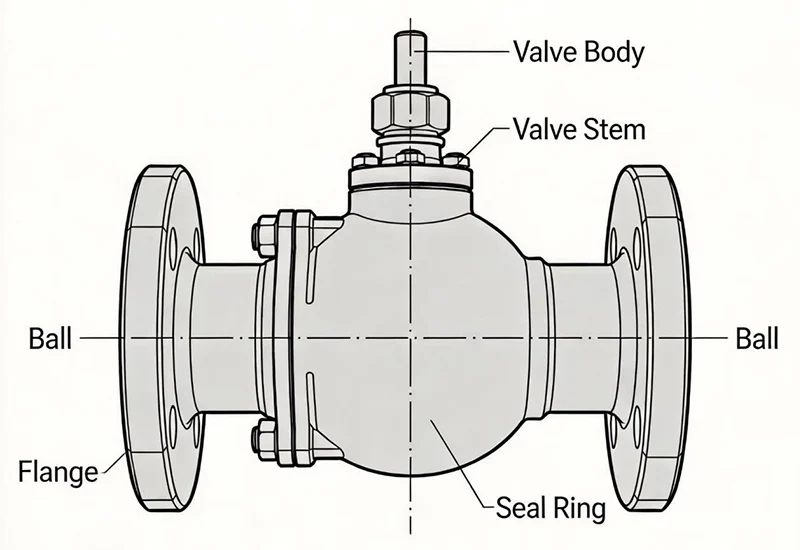
The valve’s opening and closing mechanism consists of a ported ball that rotates 90 degrees around its axis, driven by the stem, to control flow. The completely smooth valve body cavity provides a low-resistance, straight-through flow path for the medium; the full-bore design ensures virtually no fluid resistance, resulting in significant energy savings.
Sealing and Leak-Proof Structure
This valve utilizes the mechanical force exerted by the stem to wedge the ball against the seat, ensuring a reliable seal that remains unaffected by fluctuations in pipeline differential pressure. Certain seat designs incorporate spring-loaded assemblies that provide a self-tightening effect. The valve features an anti-static structure capable of dissipating static electricity generated by friction between the ball and the seat (maintaining resistance typically below 10 ohms), thereby preventing hazardous static sparks.
Stem and Safety Protection Mechanisms
The valve employs a bottom-entry stem design, complete with a back-seating structure and an integral bottom shoulder. Should the pressure of media trapped within the valve cavity rise abnormally and exceed the spring preload force, the seat automatically retracts away from the ball to relieve pressure; once pressure is released, the seat automatically resets, ensuring operational safety. A specialized helical groove on the stem works in conjunction with a guide pin to separate the ball from the seat during rotation, enabling frictionless opening and closing—effectively eliminating sealing issues caused by friction on sealing surfaces found in traditional valves.
Valve Body Structure and Ease of Maintenance
The top-entry or three-piece flanged design allows for direct in-line inspection and maintenance without removing the valve from the pipeline, significantly reducing maintenance costs. Drain ports are typically located at the top and bottom of the valve body; these can be used to check for seat leakage, drain trapped media from the cavity to minimize pollution, or relieve cavity pressure during packing replacement when the valve is in the fully open or fully closed position.
Yifa Era boasts a professional team of senior engineers and technical experts. From the selection of premium raw materials and precision manufacturing to rigorous quality control and comprehensive after-sales service, we are dedicated to providing you with the highest level of satisfaction.